

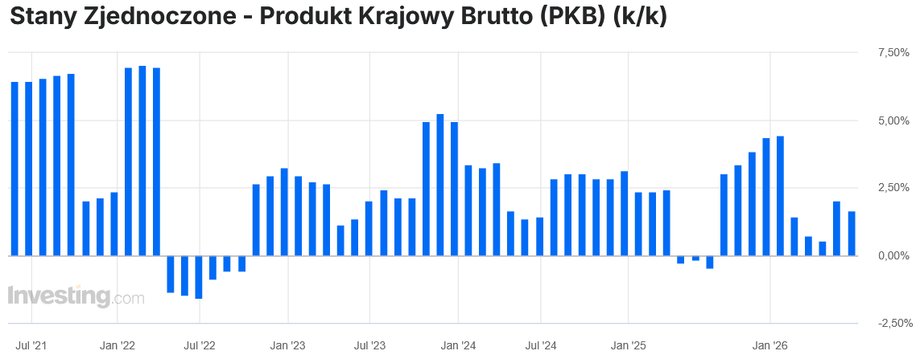
The second reading of US GDP turned out to be much less impressive than the first. The annualized rate in the first quarter increased by only 1.6%, although previously it was reported as 2%. However, another indicator, also calculated by the US Bureau of Economic Analysis, is comparable to European, including Polish, growth data.

The new US GDP reading was a significant disappointment, although on the other hand, it indirectly reduces the pressure for interest rate hikes. **Only 44% of investors in Fed rate futures on the Chicago exchange are now betting on a minimum increase of 0.25 percentage points by December this year**, compared to 53.9% earlier this morning Polish time. This is despite the rise in inflation.
Read also: Americans are paying for Donald Trump’s war. It hasn’t been this bad in three years
The annualized GDP growth rate was 1.6% in the first quarter, although the initial reading indicated a growth of 2%. The last time a higher figure (+4.4%) was recorded was in the third quarter of 2025, and a lower one (+0.5%) in the fourth quarter of 25.
Comparison with European data
The annualized rate is not directly comparable to what Eurostat or the Central Statistical Office (GUS) usually publish. In Europe, analogous quarters of the previous year are compared, while here the dynamics are checked against the previous quarter and converted to annual data. The Bureau of Economic Analysis also presented this “European” perspective, according to which, **the American economy grew by 2.6% year-on-year in the first quarter**.
For comparison, the EU economy grew by only 1% year-on-year, and the Polish economy at a rate of 3.4%.
In this view, individual consumption increased by 2.3% year-on-year in real terms, private investment decreased by 1.4% year-on-year, exports grew by 4.2%, and imports fell by 5.1%, while government consumption increased by 0.1%.
The decline in private investment was related to a reduction in housing investment (-5.1% year-on-year) and investment in non-residential buildings (-6.1% year-on-year).
Government consumption was supported by state and local spending (+2% year-on-year), while federal spending decreased by 2.9% year-on-year.
Disposable personal income of Americans increased by 0.7% year-on-year.
The inflation rate used in the GDP calculation was 3.2% year-on-year, compared to 2.4% a year earlier.
Thank you for reading our article to the end. Stay up to date! Follow us on Google.