

The threat from China, which is flooding Europe with its subsidized production, and the European Union budget for 2028-2034 are among the topics that EU leaders will address during their deliberations in Brussels on Thursday and Friday. For Warsaw, the summit will also be an opportunity to emphasize – once again – the need for a serious revision of the ETS system.
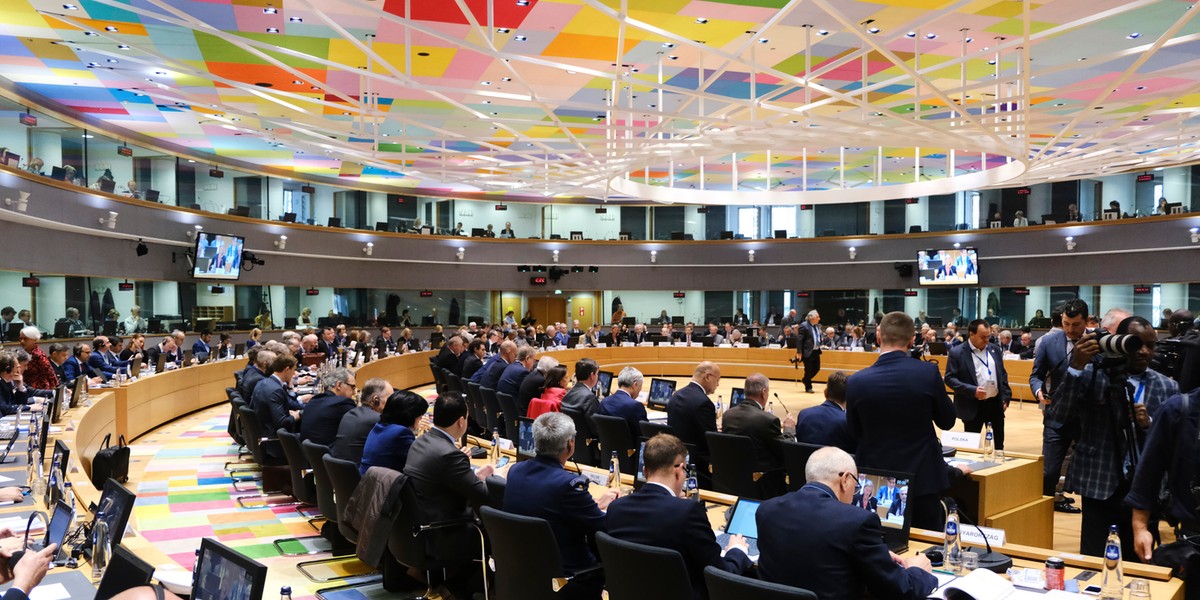
Poland will be represented at the two-day European Council meeting by Prime Minister Donald Tusk. The deliberations are scheduled to begin on Thursday at 7:45 PM. Earlier, the EU heads of state and government will meet with Ukrainian President Volodymyr Zelenskyy.
Will Europe stand up to China?
An example of how imports from China are affecting Polish industry is the chemical sector. According to the Polish Chamber of Chemical Industry, in recent years – fueled by the energy crisis and then the war in Ukraine – the European market has been flooded with supplies from foreign competitors, mainly from China and Turkey. As a result, it reports, 37 million tons of chemical industry production capacity have been shut down in Europe since 2022. This poses a threat to approximately 110,000 indirect and direct jobs.
As a source close to the government tells us, **the main topic of the deliberations will be global macroeconomic imbalances, meaning the rapidly growing import of subsidized Chinese production into the EU.** “The question is whether we will decide on a more or less assertive approach towards Beijing,” he explains. He adds, however, that no concrete decision should be expected at this stage.
According to him, apart from Spain and Hungary, which cooperate closely with China, all others rather support a firm approach. “It seems that Germany’s stance will shift to a more assertive one. We will see how Chancellor Merz behaves – that will be the crux of this Council,” we hear.
Our sources in Brussels also confirm that the main topic of the European Council will be the threats related to the imbalance in EU-China relations. “Poland is of the opinion that threats must be counteracted, especially in specific sectors. Most countries share similar positions, and Germany has also joined this group. However, there are still countries that do not want to provoke China. Mainly Spain, which has difficult relations with the USA,” describes our interlocutor.
He says that the summit’s outcome will be an announcement by the European Commission of solutions for more effective protection of the European market.
Our next source confirms that, according to the Spanish narrative, the Union must decarbonize, and free trade is key, so “we must not close ourselves off.” “We will see how Hungary behaves after the change of power,” he adds.
He also points to a problem with Germany. According to him, some Germans, mainly influential industrial corporations, prioritize short-term goals – profits earned in China – over long-term threats.
This interlocutor is also highly skeptical about whether the EU’s response to the threat from China will be adequate to the scale of the challenge. “I have no illusions that a firm stance will be reached. **We will soon be cooked in Chinese sauce; I am horrified by the blindness to the Chinese threat, and it has been like this for years**,” he emphasizes.
Hopes that it would form a dam against the Chinese flood were raised by the Industrial Accelerator Act (IAA) presented by the EC in March. Today, however, we hear voices lamenting that “the French are turning the IAA into an instrument for dividing the internal market” – pushing for solutions unfavorable to Poland, which still has a heavily emission-intensive energy mix.
x.com
ETS in Warsaw’s sights
Our interlocutors agree that, as part of the debate on EU competitiveness, Poland will raise the issue of ETS during the deliberations. “We are particularly keen for the EC to present the ‘investment booster’ announced in March by EC President Ursula von der Leyen,” says a source close to the government.
“**Warsaw is eager to mobilize the EC for an ambitious revision of the ETS; the EC is to present its proposal in mid-July**,” says our interlocutor.
Besides Poland, according to our interlocutors, supporters of a deep reform of the ETS include Italy, the Czech Republic, Slovakia, Hungary, Bulgaria, and Romania, often also Greece and Austria, and increasingly, industrially rich Belgium.
Warsaw’s argument, we hear, is that the ETS inflates energy prices, whereas they need to be lowered to protect industry in Europe.
This is confirmed by experts from the Polish Chamber of Chemical Industry in a comment for Business Insider Polska. “The revision of EU ETS should be based on greater pragmatism and take into account new economic, geopolitical, and investment realities. The pace of further increasing the system’s ambitions after 2030 must correspond to the actual technological, infrastructural, and financial capabilities of the industry, and **any proposed change should also be assessed in terms of whether it weakens the overarching goal of maintaining the EU’s strategic autonomy**,” they emphasize.
From the perspective of the chemical industry, they add, this primarily means the need to maintain strong mechanisms for protection against carbon leakage, including an adequate level of free allowances, the maintenance and expansion of indirect cost compensation, and a more realistic approach to benchmarks. “Equally important is the reform of the MSR (Market Stability Reserve) so that this mechanism effectively stabilizes the market and does not artificially limit supply and increase cost pressure,” they state.
They argue that the phasing out of free emission allowances for industry cannot precede the creation of effective protective instruments. The PIPC also reports that this is the common position of industry organizations from Poland, the Czech Republic, Slovakia, Hungary, and Romania.
Tug of war over the EU budget
Another topic for the European Council will be the multiannual financial framework of the EU for 2028-2034. “The Cypriots have proposed their negotiation framework. In three areas: the Competitiveness Fund, cohesion policy, and the agricultural policy, there is a partial agreement,” indicate our sources in Brussels.
They add that during the summit, net-paying countries (including Germany, Nordic countries, the Netherlands) will oppose this proposal, while beneficiaries, including Poland, will advocate for an ambitious budget.
However, there is still a long way to go before the budgetary negotiations are concluded. A compromise is expected before the presidential elections in France, scheduled for spring 2027.
A debate on so-called own resources, i.e., sources of revenue for the EU budget, is also expected during the summit.
“**The most important question is whether Cyprus’s proposal will be the basis for further work for Ireland, which will assume the presidency in July**,” concludes our interlocutor.
Thank you for reading our article to the end. Stay up to date! Follow us on Google.